Drexel Design Research and CIRD

Very excited to announce this article in the Bangor Daily Mail about our Graduate DSRE Practicum class’s project with Citizens Institute of Rural Design in Van Buren Maine: https://www.bangordailynews.com/2024/05/03/aroostook/aroostook-culture/van-buren-maine-drexel-university-westphal-college-historical-art-project/


Many thanks to our amazing instructor Scott Schmidt who has brought this offering to the DSRE students, and to the Town Manager Luke Dyer (who some of you met when he was here a few weeks ago) who is a force for positive change and development in his community!


Thanks also to the students who are participating in this immersive learning experience which includes interviews, focus groups, and deep dives into the Town and the culture. Excited to see where the students and class go with it!


Spring is here

We have tons of news!!

This spring, the Drexel Design Research for Health Lab joined Rebuilding Together Philadelphia to start the home visits for the Second Story Collective in their Intergenerational living efforts, and our first visit took place. These visits consist of home assessments and sharing of history to assist our community elders in living longer in their homes. https://www.secondstorycollective.org/

This Summer, Dee Nicholas will travel to Boston for the Design Research Society to present the Paper: Intergenerational creative spaces, co-living, community: Design for longevity. Nicholas, Diana Susan; Singh, Tasha; Deshpande, Tanaya; Prabhakar, Alisha; Wenrick, Rachel; Allen-Handy, Ayana. As part of DRS 2024 Paper Track 2: Design for Longevity (D4L): Project Your Future Self through Service and Technology. 

In addition, she is chairing a session she proposed at the same conference with over 40 submissions from around the world on Evidence-based practices and care: Reimagining Care Through Evidence: Design Research, Patient-Centered Solutions, And A Culture Of Care For Healthy Societies.  Nicholas, Diana Susan (1); Afzali, Minou (4); Aksamija, Ajla (2); Coleman, Nora (6); Mazzi, Angela (5); Sanders, Elizabeth B. -N. (3); Oygur Ilhan, Isil (7) Organization (s): 1: Drexel University, United States of America; 2: University of Utah; 3: The Ohio University; 4: Swiss Center for Design and Health; 5: GBBN Architecture; 6: Emory University School of Medicine; 7: University of Cincinnati. The Design Research Society is the world's longest-standing, multi-disciplinary society for the design research community. The DRS's goals are to promote research and study into the design process in all its fields and to support the interests of the design research community.

Also, Professor Nicholas' Intergenerational project Garden Fresh Home, a fresh produce growing unit for urban families was chosen for a $3,000.00 National Science Foundation (NSF) Icorps Propelus Session for the regional program April 4-26 2024. Garden Fresh Home team Shivanthi Anandan, Diana Nicholas. Team URBN Steamlab, Diana Nicholas, Shivanthi Anandan, and entrepreneurship fellow Michael Oguntuase (Drexel CCI Master's Student). https://new.nsf.gov/funding/initiatives/i-corps

Finally, Her new collection, at the Lived Places Publishing: The Human Centered Design Studies collection, has been launched; this Collection seeks work revealing lived experiences globally and locally at all scales driven by human-centered design. This collection will include course readings on health, justice, poverty, and technology situated in our challenging and complex 21st-century environment. Check it out here: https://livedplacespublishing.com/page/design-studies

Our Students have been busy too: DSRE Student Micah Lockman-Fine was involved in multiple shows this spring, Most notably the movement and fashion performance featured in the 2024 Numinous Magazine Surrealism Runway Show (April 2024). This fashion-based performance explores the linked futures of bodies with technology. Translated algorithmic codesign processes become embodied movement practice, locating human experience, desire and error inside technology and locating technological processes inside the body. Credits: Concept and research by Micah Lockman-Fine (Stoop Kids); co-choreography by Micah Lockman-Fine and Lu Donovan. Micah also Co-curated Slow-Burning Rapture (January 2024) and The Bird Ethic (November 2023) at The Schuylkill Center for Environmental Education (co-curator Kristina Murray) and had Sculptural pieces included in William Way Galleries' 18thAnnual Juried Art Exhibition.

Sepha Sugrue will show her Design Research Thesis, Support for women who are psychiatric service users with narrative Needlecraft, at the Drexel Emerging Graduates Conference in April Josepha Sugrue D.S. Nicholas, Design Research Program.

Fall 2023 Doings: Design Research, Our Lab, and Beyond!

2023 Design Research Symposium

On October 14th, The MS Design Research Program, Design Philadelphia, and the Philadelphia chapter of the Service Design Network hosted the 8th annual Design Research Symposium entitled “Aging and Health: Catalysts for Change,”. This event included a panel of experts from the region, including Penn and Drexel, and a design sprint exploring how aging can be better accommodated in Health Care environments. Micah Lockman Fine, a Design Research first-year student (DSRE 2025) had this to say about the event: “At the 2023 Drexel Design Research Symposium, my fellow students, community members and I learned to problem-solve using the Design Research method. In the panel discussion, leaders in the healthcare and housing fields introduced new frameworks for aging as future-oriented expertise. Applying these frameworks to healthcare and housing models could fundamentally shift conditions for aging community members, attitudes towards preventative and population health, and improvements in end-of-life care.

During the Design Sprint, we attendees divided ourselves into three groups: Aging in Place and Health Environments; Aging and Population Health; and Hospital Readmissions and Aging. I joined the first, inspired by the work of Drexel Design Research for Health Lab and Second Story Collective. Second Story Collective brings together students and Philadelphia locals, prototyping community-driven, equitable development for historically marginalized Black communities. Accordingly, my group sought to tackle the rift in Philadelphia between younger university students and Philadelphia locals. We observed that many undergraduate university students only interact with University City or some North Philadelphia neighborhoods, systems, and communities.  This behavior compounds decades of distrust by Philadelphia locals as a result of universities’ rapid and intentional gentrification and displacement of Philadelphia locals from their own neighborhoods.

 We considered solutions that address institutional history and bias, such as prioritizing hiring locally, expanding scholarship programs for Philadelphia locals, and implementing a student direct service program in partnership with community leaders, where students could assist local elders with daily tasks; solutions that share university resources, such as technology and lab equipment courses and public access; and two-way, power-level implementation strategies, such as paying community leaders to develop orientation materials.

The event marked my personal introduction to the Design Research method in practice. I was impressed by the thoroughness of information, clear communication, and emphasis on idea sharing and uplifting other group members. As we approach such complex problems, it’s useful to learn precedent, protocol, and ways leaders in their fields have gotten work done.”

A short booklet detailing this event can be found here:

https://issuu.com/mouthoflowers/docs/dsresymposiumconference

Many thanks to Design Research GA Micah Lockman Fine for creating the book!

Design Researchers Travel abroad to present their work:

D.S. Nicholas, DSRE program Director presented her collaborative paper at the International Conference of Education Research and Innovation 2023 in Sevilla, Spain, on Design Thinking in Higher Education, documenting her efforts to assist with Program Innovation: Design Thinking And New Program Innovation: Case Study Research In Higher Education Evolution Post Pandemic. Design Research dual degree Alumna Elise Krespan (DSRE/BIO 2018) and Nicole Feller Johnson (DSRE/FASH 2018) Presented their paper drawn on their experience as the developers of the DSRE elective course that they have developed and taught for five years called Design and Disruption. Their paper was entitled Student Archetypes In Disruptive Design Education, and it covers their efforts to create personas and creative archetypes as a way of understanding the creative processes that students develop in their work.

Citations for both papers:

Krespan, E., & Feller-Johnson, N. (2023). Applied Student Archetypes In Disruptive Design Education. ICERI2023 Proceedings, 8540–8546. https://doi.org/10.21125/iceri.2023.2175

Nicholas, D., & Anandan, S. (2023). Design Thinking And New Program Innovation: Case Study Research In Higher Education Evolution Post Pandemic. ICERI2023 Proceedings, 6032–6039. https://doi.org/10.21125/iceri.2023.1508

Professor Dee Nicholas then traveled to Swiss Center for Design and Health AG (SCDH) in
Bienne/Biel Switzerland, to complete the final phase of her Qualitative Case Study entitled: Design Thinking for Health Environments: Case study research on design innovation and health complexity. Her work centers on understanding innovative environments and health. The SCDH seeks to improve the design of spaces, products, services, interactions, and processes through evidence-based design. While at the center, she conducted interviews and observations that she will present back to the team there in Winter 2024.

Makers-giving in the Graduate Studio:

This past Monday, professors, staff, alumni, and current students met in the MS Design Research Studio for the first annual Makers-giving Event, an opportunity to get to know each other through what we make. Folks brought something they made to swap at our event; on offer were homegrown spice mixes, drawings, sculptures, cards, handmade logos, and music! Much fun and connections were forged, and we met the newest design research baby brought by alumni and new momma Allison (DSRE 2023). Program Alumna Roz (DSRE 2019) shared some amazing cards she made as part of her larger body of work that can be seen on her website: https://rozphotoblog.wordpress.com/ and Fine Arts Professors Joshua Weiss and Lewis Colburn both brought work to swap. New student Design Research student Tyler Fulton (DSRE 2025) brought original music to swap with the group. This event will be held annually so if you missed it this time around, come by next time…

Second Story Collective Presents…

In September and October, members of Second Story Collective (SSC) including Program Director Dee Nicholas presented at several outlets in the Philadelphia area with Developer Charles Lomax, and Writers Room Founder and Executive Director for Arts and Civic Innovation Rachel Wenrick; These projects are supported by research assistants form Design Research including Alisha Prabhakar (DSRE 2023) and MS Interior Architecture and Design Tanaya Deshpande (IARC 2023) and Tasha Singh (IARC 2023).

These events included: 2023 September 26th Panelist with South Street Headhouse District Katrina Johnston-Zimmerman, Assistant Director; North 10: Joshua Klaris, Executive Director; Temple University Public Policy Fellow/ Community Engagement Professional: Naida Elena Montes, Ph.D; Second Story Collective:  Charles Lomax, Chairman & CEO, Lomax Real Estate Partners; D.S. Nicholas, Associate Professor and Founding Director MS Design Research, Drexel University; Rachel Wenrick, Executive Director for Arts & Civic Innovation, Drexel University

Glen-Gery. “Trailblazers in Community Development [Philadelphia].” https://www.glengery.com/node/4121. On October 18th SSC did an Invited workshop Second Story Collective: A blueprint for community co-design and engagement at the 2023 PACDC Equitable Development Conference https://pacdc.org/2023-pacdc-equitable-development-conference-register-today/.

Design Research Social Hour

On November 30th, Beth Cain and Veronica Yeung for the Philadelphia Service Design Lab, joined our monthly DSRE Social Networking lunch. Veronica works as a Service Designer and has been part of the lab for the past 4 years and Beth recently joined the lab as the Research and Evaluation Lead. They shared several awesome projects the team is working on and answered questions on how the city approaches collaborative partnerships from a design perspective. The Service Lab is celebrating the launch of their new toolkit, which took three years of hard work and involved more than a dozen community partners to create. It can be found at the link below: https://engagement-toolkit.phila.gov/

 We'll be on break for December but will return in the New Year. Our next DSRE Social Networking Lunch will be January 18th at 12:00pm. We look forward to seeing you then! 

Reach out to dsn35@drexel.edu for more info!

Rankin Event 2023

Our January 2020 Rankin event:

Dr. Liz Sander was this year’s Rankin -in-Scholar for Drexel Westphal College of Media Arts & Design, hosting a lecture and workshop on her MAKETOOLS process. Students, community members and professionals worked together to create present state & future state outcomes for local Philadelphia organizations based on existing situations needing solutions. partners included St. Christopher’s Hospital, Penn Medicine, Empathic CoDesign Lab, Second Story Collective, and Penn Medicine:

OUR SHORT BOOKLET ABOUT THE EVENT CAN BE FOUND HERE:

MAKETOOLS BOOKLET

VISION Keynote: Design Research AIA CINCINNATI by D.S. Nicholas

VISION Keynote: Design Research in Healthy Spaces: A Session on Research, Analysis and Social Responsive Architecture Practice

Program Overview

Advance registration required before 3pm on May 19.

This lecture and engagement session will introduce participants to the Design-Led Co-Strategy for Health Lab, through our method for engagement with stakeholders and the integration of qualitative stakeholder engagement into collaborative design processes. Participants will learn and understand low impact ways that research and evidence-oriented practices can yield high impact possible results for the project stakeholders and their target goals in the health arenas.

Evidence based design and post-occupancy evaluation are important components of health, building, and design practice. This session draws out how research, and evidence, can play an even stronger part in the design, deployment, and community practices inherent in many projects. The goal here is to give participants simple tools to use basic empirical research to further augment the welfare of those who will ultimately use the buildings and spaces, as the projects are being designed with the community stakeholders at the table.

Link to the event is here

ICERI 2022 PRESENTATION

In Sevilla, Spain to present:

DESIGNING FOR CREATIVE RESEARCH IN GRADUATE EDUCATION

T. Hurwich, D. Nicholas, F. Fleming, P. Gondek, J. Katz-Buonincontro, D. King, E. Perignat

Drexel University (United States)

Abstract

Developing competence with creativity is critical to graduate students’ training but is often unaddressed in graduate education. Creativity is an essential 21st Century skill necessary to graduate students’ training. Addressing the need for student training requires a preliminary step of sharing the experiences of designing courses and training programs in creativity to support student training. An instructional team consisting of a design expert, two educators, a social scientist, and a scientist/humanist used research- based best practices from literature on design thinking, creative thinking, and teaching to facilitate the innovative approaches of approximately 30 student researchers over four years. The team designed, trained, and iterated two courses: one surveying team-based creativity principles and procedures and the other focusing on enhancing the creativity of individual research projects.

The courses’ goals were to:

(1) provide students with a deeper understanding of the nature of creativity in research. (2) equip students with strategies and tools to develop their creative processes.

(3) provide students with firsthand experience in understanding how diverse disciplines approach creative research—and research in general, and give students opportunities to draw from disparate fields to find innovative strategies to employ in their research.

(4) help students work effectively in interdisciplinary teams and gain tools to address some challenges created by working together.

Findings in this paper, based on focus groups, planning documentation, project reports, and student- and instructor-generated artifacts, were used to determine the courses’ successes and challenges. Methods used to arrive at the insights in this paper include formal document analysis, participant reflective writing, and qualitative coding of existing research and production artifacts. Explicitly discussing and teaching multiple ways to understand creativity along with diverse creative practices led to students who were better able to gauge their creative ability and gained an understanding of how to leverage the skills taught in the courses to their research. Students reported that the courses added nuance to their understanding of creativity and their own creative processes that allowed them to understand how to continue to improve their creative output. The paper additionally shares struggles in designing and implementing an interdisciplinary program, particularly with regards to recruiting students to enroll in the courses and helping instructors manage their overall work load. The case study aligns with emerging higher education trends with respect to graduate experience due to the fact that students found the explicit teaching of creativity and creative practices to be beneficial, while professors require institutional support that addresses interdisciplinary enrollment, and a reward system for collaborative teaching. The paper provides data and experience that is likely of benefit to future endeavors to foster graduate students’ creativity, teamwork, and interdisciplinary research.

Keywords:

Interdisciplinary Design thinking, Creative Teams, Graduate Education, STEM Education,

Health Design Research Class presentation


JOIN US!!!!!

Healthy Communities Task Force

The next Healthy Communities Task Force meeting is scheduled for:

this Wednesday, April 20th from 11 am-12 pm. We hope to see you there (virtually)!

This meeting will feature graduate students from Drexel University's Dornsife School of Public Health and Westphal College of Media Arts and Design, who will join us to share their recent research on public health, design, and the built environment. Students worked with different community-based organizations, including Fabric Health, Writer’s Room, IMPACT Services, and the Domestic Violence Center of Chester County, to examine social determinants of health and develop innovative solutions to community challenges. An agenda and speaker bios can be found here.

If you have not registered but would like to attend:

please register to join the virtual conversation:

https://dvrpc.zoom.us/meeting/register/tZUvcuyqqTojGNAubLz_efGLjJuk6ozdN_bl.

We had great discussions on how health and equity connect to many different aspects of planning, including transportation, climate change, and mortgage lending. We wrapped up our webinar series with a student research showcase, featuring two innovative student projects from a Drexel University design and public health course. Meeting materials, including agendas, meeting highlights, and recordings (for some of the meetings), are available on the HCTF website:

https://www.dvrpc.org/Committees/HCTF/

https://www.dvrpc.org/Committees/HCTF/2022-04.pdf

Design Research Symposium 2022

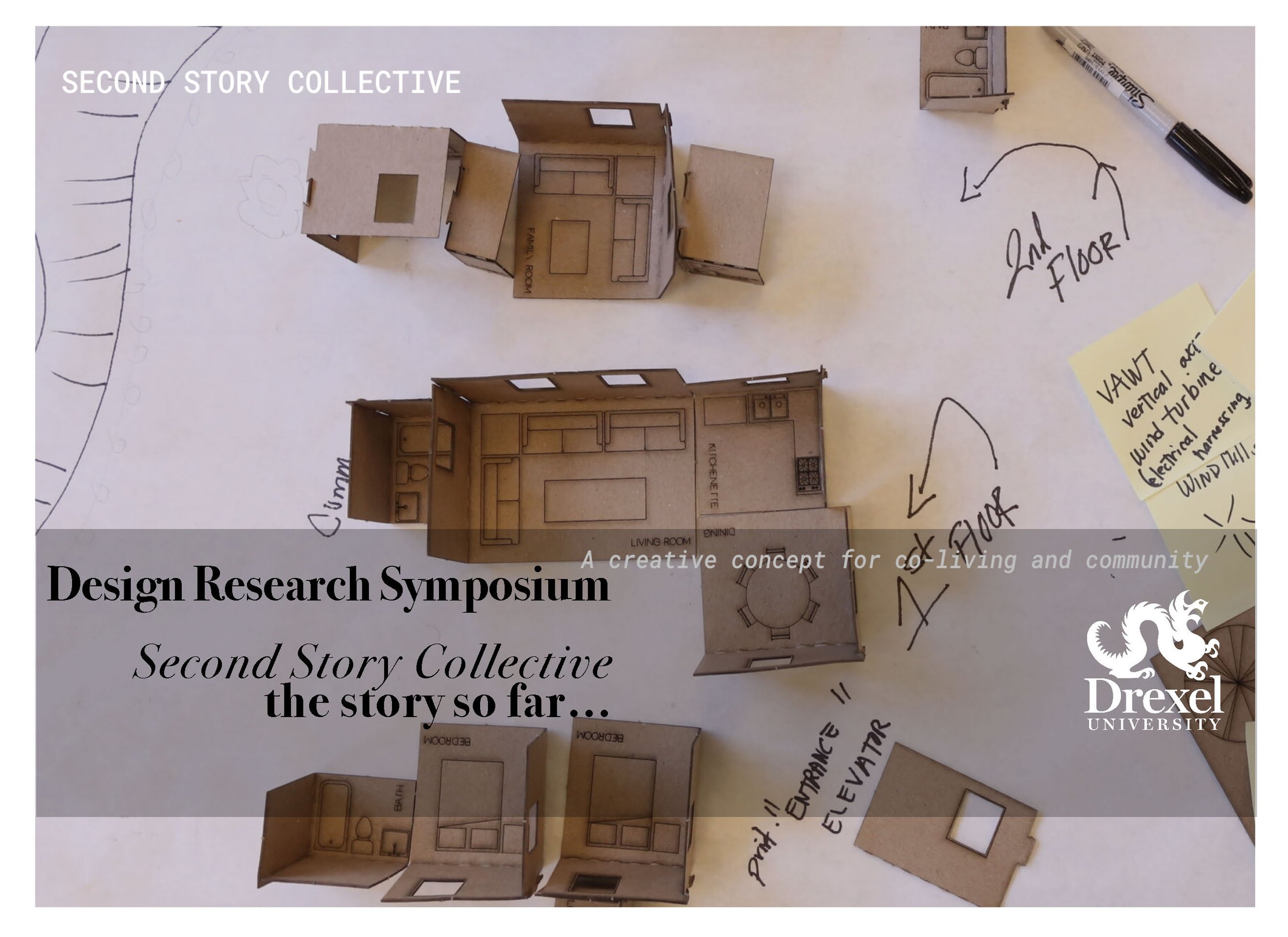
Design Research Symposium 2022: Second Story Collective: the Story So Far

Second Story Collective is a collaborative venture of Drexel’s Writers Room. This collective of artists, activists, architects, and West Philadelphia residents is united by a vision: shared living space and shared stories can create a foundation for meaningful co-habitation.  The Design Research Symposium on Friday, April 15 will be an interdisciplinary event exploring concepts of home, co-design, and the power of story to create connections across difference. 


Schedule of Events

12:30 PM doors open + welcome

1:00 PM (concurrent sessions)

3:00 PM Memento: participatory co-design workshop with Kia Weatherspoon and Sequoyah Hunter-Cuyjet

5:00 PM Open House: reception + story-sharing


"We design to change lives." – Kia Weatherspoon 

Join us for a dynamic talk and workshop experience with Kia Weatherspoon and Sequoyah Hunter-Cuyjet of Determined by Design as they share how their work is inspired by history, fashion, and nature and how their advocacy for Design Equity continues to shift the affordable housing narrative, making interior design a standard for all. 

Their short talk will be followed by a hands-on workshop in which you can create a memento box honoring the history of your home and family. Attendees should bring their own objects to work with during the session.

The talk will be streamed online and open to all. In person attendance for the walking tour and workshops is limited. Participants will receive a curated package of art and print materials. 

Free registration is required. Register here.


Supported by the Pennsylvania Council on the Arts, The Barra Foundation, AmeriCorps, and Westphal College of Media Arts & Design.